
In 2026, the BYD Qin Plus DM-i matters because many drivers want EV-like commuting without full EV pressure. It lets owners cut fuel use, keep routine trips simple, and avoid charging anxiety.
The Qin Plus fits daily city life because it stays compact and easy to place on the road. You park it in tight spaces, see corners clearly, and feel relaxed at low speeds.
For 2026, BYD focuses on smoother hybrid logic, cleaner software response, and quieter cabin behavior. Small updates in screens, menus, and switch feel also reduce daily friction for regular users.
As a long-term car, Qin Plus DM-i suits owners who value steady running costs and calm usability more than excitement. Let’s explore how it works in real routines, year after year.
2026 BYD Qin Plus
The 2026 BYD Qin Plus DM-i is a front-wheel-drive plug-in hybrid sedan built for efficiency and repeatable daily driving. It uses a simple sedan layout, practical doors, and easy cabin access.
Owners use it like two cars in one. For short trips it behaves like an electric car, then for longer drives it leans on petrol support without asking for charging stops.
BYD designs it around ownership basics; low fuel spend, flexible charging, stable drivability, and fewer surprises. If you charge often, you reduce petrol use and keep costs more predictable.
Must Look Specifications of 2026 BYD Qin Plus DM-i
| Car Name | 2026 BYD Qin Plus DM-i |
| Body type | 4-door compact sedan |
| Seating capacity | 5 seats (best comfort for 4 adults) |
| Platform type | BYD DM-i plug-in hybrid architecture |
| Engine type | 1.5L Atkinson-cycle petrol |
| Electric motor output | ~145 hp (108 kW) |
| Total system output | ~190 hp (142 kW) |
| Battery capacity (kWh) | ~13.5 kWh (SR) / ~18.3 kWh (LR) |
| Charging type + time | AC charging, ~2.5–4.5 hrs (0–100%) |
| EV-only range | ~55–70 km (34–43 mi) SR / ~80–100 km (50–62 mi) LR |
| Real-world blended fuel economy estimate | ~3.9–4.8 L/100 km (49–60 mpg US) with regular charging |
| Transmission type | E-CVT / dedicated hybrid unit |
| Drivetrain | Front-wheel drive |
| Tire size range | 205/55R16 to 215/50R17 |
| Estimated pricing | ~US$16,000–24,000 equivalent (tax dependent) |
| Safety technology level | AEB + lane support + camera aids (varies by market) |
| Warranty expectations (battery + vehicle) | Battery ~8 yrs / 160,000 km; vehicle ~4–6 yrs typical |
Exterior Design & Dimensions
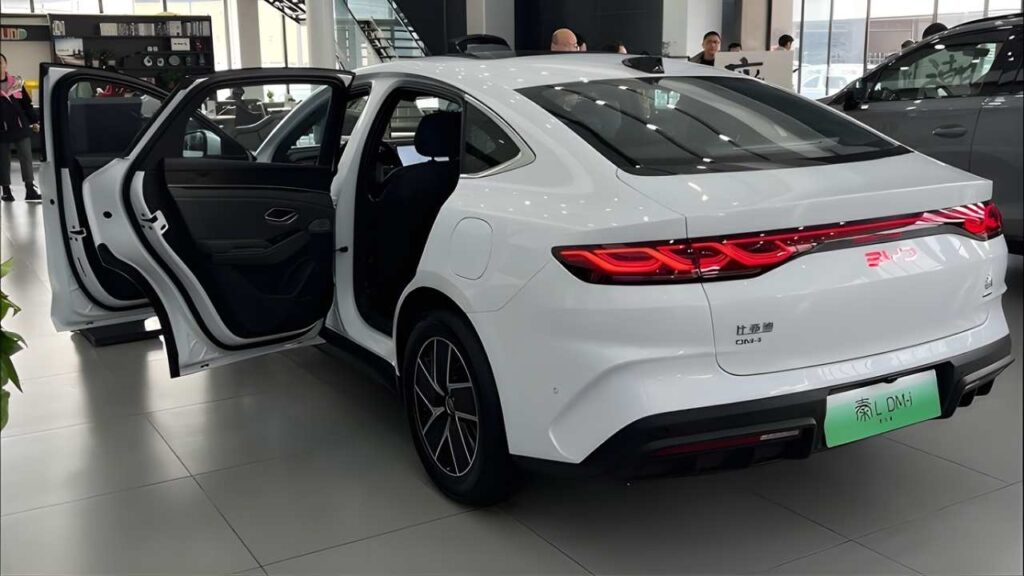
Qin Plus keeps a neat sedan outline with smooth, aero-friendly surfaces. Drivers get clear sightlines, easy parking in tight spaces, and enough ground clearance to handle ramps, rough patches, and everyday speed bumps without stress.
Its body measures about 4,760 mm (187.4 in) in length, 1,835 mm (72.2 in) in width, and 1,495 mm (58.9 in) in height, with a 2,718 mm (107.0 in) wheelbase and 1,520–1,680 kg curb weight.
Mechanical & DM-i Powertrain Focus
DM-i works in an electric-first way. The motor handles most city movement, while the petrol engine supports higher speeds, steep climbs, and low battery conditions. Efficiency stays the priority, not sporty response.
- Petrol engine role: Maintains speed, supports power, helps when charge drops
- EV motor in traffic: Smooth pull, light effort, easy creeping
- Regen braking feel: Strong but learnable; smoother after habit forms
- Battery cooling: Designed for daily cycles; heat management matters in summer
- Charging routine: Home AC works best; workplace charging helps a lot
- Service pattern: Still needs oil and filters, but engine runs less in city use
BYD Qin Plus DM-i 2026 Variants
| Variant | Battery (est.) | EV range (est.) | Daily-use upgrades |
|---|---|---|---|
| Standard Range | ~13.5 kWh | ~55–70 km (34–43 mi) | Core safety, basic screen, durable seat trim |
| Long Range | ~18.3 kWh | ~80–100 km (50–62 mi) | More EV days, added comfort features |
| Premium / Pro | ~18.3 kWh | ~80–100 km (50–62 mi) | Better seats, quieter cabin, stronger ADAS |
| Tech Edition | ~18.3 kWh | ~80–100 km (50–62 mi) | Better cameras, larger display, connectivity |
All trims share the same efficiency-focused hybrid setup. Your trim choice changes comfort and convenience more than speed. Owners usually feel the difference in quietness, screen ease, and parking support.
Launch & Availability
| Region | Availability expectation |
|---|---|
| China | Wide availability |
| Southeast Asia | Gradual rollout, strong in major cities |
| Middle East | Select distributors and markets |
| Latin America | Limited early supply |
| Europe | Selective markets only |
BYD often staggers supply by region. Features can change by market, especially charging ports, safety aids, and trim naming.
Performance & Driving Character
In daily use, the Qin Plus feels like an EV at the start. It moves quietly from traffic lights, then blends in the petrol engine mainly at highway speeds or when the battery buffer runs low.
| Scenario | Feels Like | What the owner notices | Efficiency expectation |
|---|---|---|---|
| Slow city commute | EV | Quiet drive, smooth pull | Very high |
| Suburban mix | Hybrid | Engine joins briefly | High |
| Highway cruise | Petrol-supported | More engine presence | Moderate-high |
| Steep climbs / full load | Hybrid + engine | Stronger sound, more effort | Drops |
| Low battery driving | Efficient hybrid | Engine runs more often | Moderate |
City driving stays easy and calm. On highways, it feels stable and quiet for the class, with light steering. Brakes can feel slightly different depending on regen level, but it stays predictable.
Interior Layout & Practicality
Seats focus on everyday comfort rather than sporty grip. The driver sits in a natural position with good forward view, and mirrors help lane checks. Rear space suits adults for normal trips, though three adults feel tight.
Child seats fit easily with a simple rear bench layout. Cabin storage works for daily items: bottles, phones, and small bags. The trunk keeps a usable shape, but PHEV packaging may reduce underfloor space.
Technology & Controls
- Infotainment: quick menus, clear icons, normal response
- Climate control: best when key settings stay easy to reach
- Instrument panel: clear EV range and fuel info
- Phone pairing: stable Bluetooth matters more than apps
- Driver assist: easy to adjust; quick disable helps in heavy traffic
Tech works best when it stays simple. Owners care more about speed and reliability than fancy features.
Fuel Use & Ownership Considerations
- Real EV range often reaches 70–90% of the dash claim
- If you charge daily, fuel use can drop near 4.0 L/100 km in mixed life
- If you rarely charge, it behaves like a heavy efficient hybrid sedan
- For battery health, prefer 30–80% charging most days
- Oil and filters still matter (time-based service even with low engine use)
- Battery range slowly drops over years; heat and high miles speed it up
- Front tires wear faster; rotate often
- Insurance can cost more than petrol models in some markets
- Biggest savings come from stable charging access
Ride Comfort & Handling Balance
The suspension targets comfort on rough city roads. It absorbs small bumps well, but sharp potholes still register through the wheels. On long highway drives, it stays steady with low fatigue.
Safety & Driver Assistance
BYD aims for modern everyday safety: a strong cabin, useful airbags, and driver aids that reduce stress. The best systems support the driver without constant warnings.
- Multiple airbags and reinforced body design
- AEB, lane support, adaptive cruise (trim/market dependent)
- Parking sensors, reverse camera, 360 camera on higher trims
- Driver alerts for lane drift and attention (spec dependent)
- Helpful systems that you can tune easily
BYD Qin Plus DM-i Price 2026
| Market | Estimated range |
|---|---|
| China domestic estimate | ~US$16,000–19,500 |
| Export estimate (SEA / Middle East) | ~US$19,000–24,000 |
| Note | On-road cost varies with taxes, incentives, and dealer fees |
Prices shift by tax rules and hybrid incentives. For ownership, parts supply and service reach matter a lot. Strong dealer support reduces repair delays and makes long-term use easier.
Who Should Buy the 2026 BYD Qin Plus DM-i?
This car suits commuters who can charge at home or at work and want low fuel spend without full EV dependence. It fits cost-focused owners who want calm daily driving and simple routines.
This may not suit drivers with zero charging access, since savings shrink fast. It also won’t satisfy performance-focused buyers, or families that need very large rear space and maximum trunk volume.