
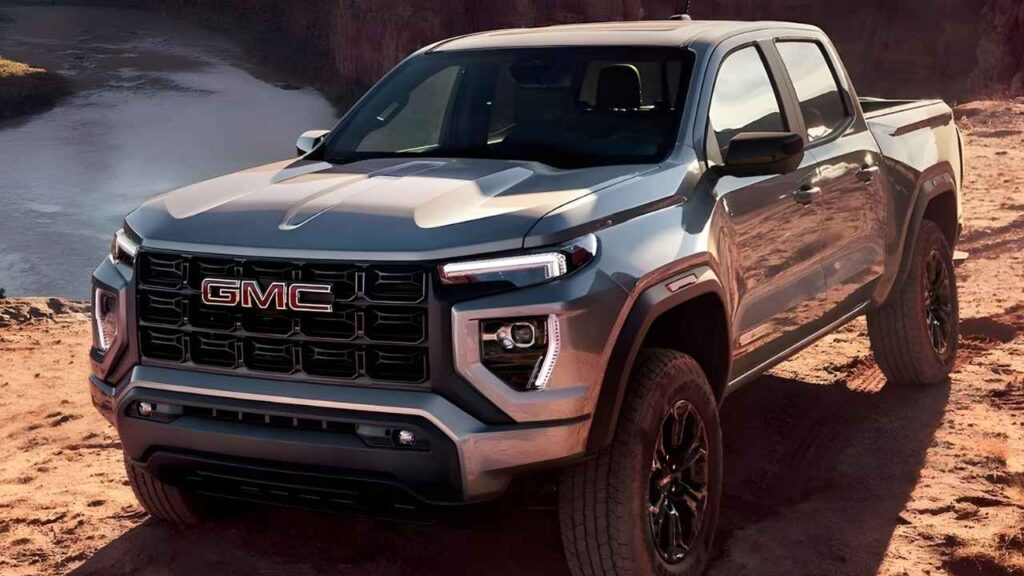

Off-road-oriented pickups exist because many owners need vehicles that tolerate repeated punishment rather than rare challenges. Durability, ground access, and structural tolerance matter more than outright performance when surfaces remain inconsistent day after day.
The 2026 GMC Canyon reflects this thinking by focusing on repeatable behavior rather than occasional extremes. It is intended to be used often, in places where pavement ends and conditions are rarely uniform.
This type of pickup occupies a practical middle space. It is more resilient than standard road-focused trucks but avoids the compromises of highly specialized machines.
Long-term use highlights patterns rather than moments. Owners tend to notice how calmly the vehicle reacts to rough inputs, where steady control and predictability become more important than peak capability.
2026 GMC Canyon
The Canyon is a midsize, body-on-frame pickup built around a traditional ladder chassis. Its longitudinal drivetrain layout and selectable four-wheel drive are designed for regular exposure to loose and uneven surfaces.
Overall dimensions of roughly 5,400 mm (213 in) in length, about 1,900 mm (75 in) in width, and near 2,030 mm (80 in) in height place it in a manageable size range. A curb weight close to 2,050 kg (4,520 lb) provides stability without overwhelming narrow trails or daily access points.
From daily use, hood height and forward visibility help with obstacle placement rather than appearance. The bed’s height and rear placement allow clearance on uneven ground while remaining usable for routine loading.
Must Look Specifications of 2026 GMC Canyon
| Model Name | 2026 GMC Canyon |
| Frame type | Fully boxed steel ladder frame |
| Curb weight | approx. 2,050 kg (4,520 lb) |
| Engine options | 2.7 L turbocharged inline-four |
| Power output | approx. 231 kW (310 hp) |
| Torque output | approx. 583 Nm (430 lb-ft) |
| Transmission | 8-speed automatic |
| Drivetrain | Rear-wheel drive / selectable four-wheel drive |
| Transfer case | Two-speed |
| Ground clearance | approx. 245 mm (9.6 in) |
| Approach angle | approx. 33° |
| Departure angle | approx. 23° |
| Suspension setup | Independent front, solid rear axle |
| Tire size | up to 33 in all-terrain |
| Bed length | approx. 1,560 mm (61 in) |
| Payload rating | approx. 720 kg (1,590 lb) |
| Towing capacity | up to 3,500 kg (7,700 lb) |
| Fuel consumption (combined) | approx. 11.8 L/100 km (20 mpg) |
In daily use, these numbers translate into controlled progress rather than sudden limits. Loads, slopes, and surface changes are handled gradually, reducing fatigue over long periods.
Frame Strength and Long-Term Trail Use
The ladder frame resists distortion after repeated uneven loading. Underbody protection reduces cumulative damage from stones, ruts, and shallow obstacles.
Over time, structural rigidity becomes evident during slow articulation. Panel alignment and door operation remain consistent despite frequent chassis twisting.
Engine Behavior on Road and Off Road
The turbocharged engine delivers usable torque at low speeds, supporting smooth movement without frequent throttle adjustments.
| Surface | Throttle Behavior |
|---|---|
| Pavement | Even and linear |
| Gravel | Controlled, minimal surge |
| Low-speed trails | Strong low-end response |
Power delivery remains calm across surfaces, allowing steady movement rather than constant correction.
Transmission, Gearing, & Low-Speed Control
The automatic transmission emphasizes smooth engagement over quick shifts, aiding balance on loose ground.
- Low-range gearing supports consistent crawl speeds
- Gear changes avoid abrupt transitions
- Hill starts feel deliberate and stable
Steering, Turning Radius, and Control
Steering effort remains moderate across speeds, supporting long drives and precise placement.
- Predictable response during tight maneuvers
- Turning radius suits narrow trails
- Wheel placement remains accurate on uneven ground
Consistency in steering feedback helps maintain confidence when surfaces change rapidly.
Suspension Travel and Surface Response
Suspension tuning prioritizes control when surfaces vary unexpectedly.
| Surface | Ride Behavior |
|---|---|
| Smooth roads | Firm but settled |
| Broken pavement | Dampened impact transfer |
| Uneven trails | Progressive articulation |
Ride Comfort With Off-Road Hardware
On paved roads, the ride feels structured rather than soft. Small imperfections are absorbed without repeated body movement.
Off pavement, damping keeps wheels planted and body motion controlled. The truck settles quickly after obstacles instead of oscillating.
Cabin Layout and Everyday Usability
The cabin favors upright seating and outward visibility, supporting long hours without constant adjustment.
| Aspect | Ownership Impression |
|---|---|
| Seating position | Upright and supportive |
| Storage areas | Practical and accessible |
| Long-drive comfort | Maintains comfort over distance |
Controls, Displays, and Terrain Aids
Controls remain straightforward after extended exposure to dirt and vibration.
- Drive modes are easily selected
- Camera views assist with wheel placement
- Systems engage reliably in repeated use
Pickup Bed Use in Off-Road Scenarios
The bed proves most useful when carrying tools and equipment across uneven ground.
| Feature | Practical Effect |
|---|---|
| Bed length | Accommodates common gear |
| Access height | Requires deliberate lifting |
| Gear stability | Secure under rough movement |
Payload and Towing on Uneven Ground
With moderate payloads, suspension compression remains predictable. Braking performance stays consistent on loose or uneven surfaces.
When towing off road, stability systems intervene smoothly. Directional control is maintained without abrupt corrections.
Fuel Use and Range in Mixed Conditions
Fuel consumption increases steadily with terrain difficulty rather than unpredictably.
| Driving Condition | Fuel Use |
|---|---|
| City driving | approx. 13.0 L/100 km (18 mpg) |
| Highway cruising | approx. 10.2 L/100 km (23 mpg) |
| Off-road use | approx. 15.5 L/100 km (15 mpg) |
Safety and Off-Road Assistance Systems
Assistance systems operate subtly during routine use.
- Traction systems adapt to loose surfaces
- Alerts remain restrained
- Stability control intervenes progressively
Pricing & Ownership Context
Pricing sits toward the higher end of midsize off-road-focused pickups, reflecting structural hardware rather than cosmetic features.
| Item | Approximate Value |
|---|---|
| Entry pricing | USD 39,000 |
| Typical ownership range | USD 44,000–52,000 |
Long-term costs are dominated by fuel, tires, and brake wear rather than unexpected mechanical issues.
Maintenance & Long-Term Care
Service intervals follow conventional schedules, though frequent off-road use benefits from more regular inspections.
| Warranty Coverage | Term |
|---|---|
| Basic vehicle | 3 years / 60,000 km (36,000 mi) |
| Powertrain | 5 years / 160,000 km (100,000 mi) |
Tires and wheel alignment, Brake components, Suspension bushings, Skid plates, and Differential and transfer case fluids
Who This Pickup Fits Best
The Canyon suits owners who rely on their trucks regularly rather than occasionally. Those drivers frequently leaving paved roads, owners carrying gear across uneven terrain, and long-term users prioritizing consistency must choose this 2026 Canyon of GMC.
How It Handles Daily Driving and Rough Terrain
With time, the Canyon becomes predictable in routine driving. The off-road-oriented suspension slightly firms urban rides but offers consistency when pavement breaks down or disappears entirely.