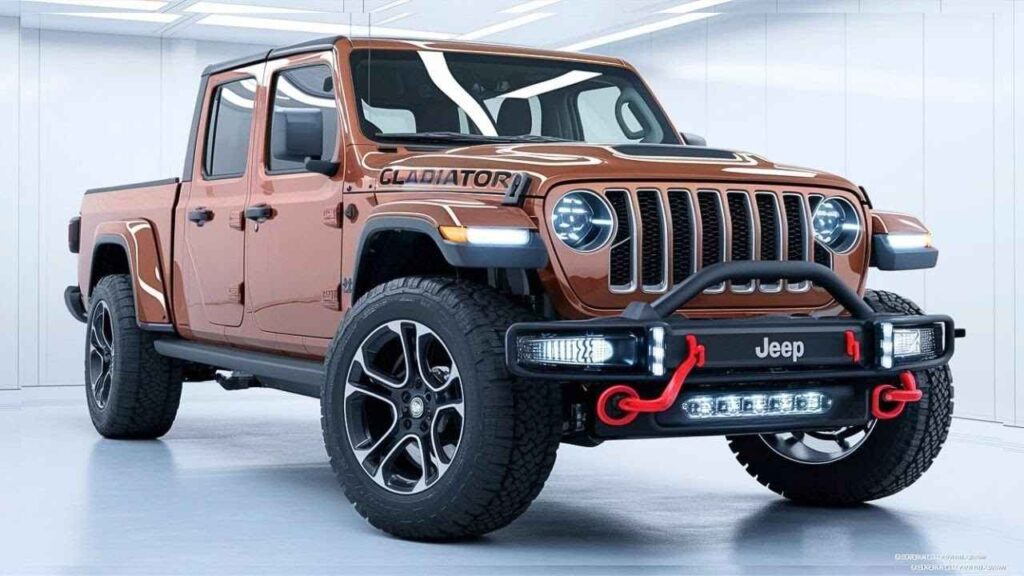

The 2026 Jeep Gladiator Pickup Truck exists because some buyers want a pickup that still feels like a truck, but not one that overwhelms daily life. It needs to fit normal roads, normal parking spaces, and normal routines, while still carrying weight and handling rough access.
The Gladiator does not replace a full-size pickup. It also does not behave like a compact one. Jeep positions it deliberately in the middle, where size and strength feel usable rather than excessive.
What separates the 2026 Jeep Gladiator Pickup Truck is that it keeps traditional truck construction at this scale. It uses a body-on-frame layout, solid axles, and a visible structure instead of car-based engineering.
This makes the Gladiator less about comfort tricks and more about consistency. It feels the same loaded or unloaded, on pavement or broken ground, which is what many long-term owners value.
2026 Jeep Gladiator Pickup Truck
The 2026 Jeep Gladiator is a mid-size, body-on-frame pickup with four doors and a short cargo bed. It uses a traditional ladder frame and solid axles, which shape how it rides, turns, and carries weight.
At 5,537 mm long (218 in) and around 2,130 kg (4,695 lb), it feels substantial without crossing into full-size territory. You notice its size when parking and turning, but it stays manageable in daily use.
The removable roof and doors add flexibility, while the pickup bed keeps it practical rather than decorative. The Gladiator does not try to soften its character. Its upright shape, visible hardware, and simple layout make it easy to understand and easy to live with once familiar.
Jeep Gladiator Pickup 2026 Specification Review
| Model Name | Jeep Gladiator Pickup Truck 2026 |
| Vehicle Class | Mid-size pickup truck |
| Body Construction | Steel ladder frame |
| Seating Capacity | 5 occupants |
| Cab Style | Four-door crew cab |
| Engine | 3.6 L naturally aspirated petrol V6 |
| Maximum Output | 213 kW (285 hp) |
| Maximum Torque | 352 Nm (260 lb-ft) |
| Transmission | 8-speed automatic |
| Drive System | Four-wheel drive |
| Fuel Type | Regular unleaded |
| Fuel Tank Capacity | 83 L (22 US gal) |
| Combined Fuel Use | approx. 12.4 L/100 km (19 mpg US) |
| Overall Length | 5,537 mm (218.0 in) |
| Overall Height | approx. 1,860–1,940 mm (73–76 in) |
| Wheelbase | 3,487 mm (137.3 in) |
| Curb Weight | approx. 2,130 kg (4,695 lb) |
| Gross Vehicle Weight Rating | 2,631 kg (5,800 lb) |
| Rated Towing | up to 2,041 kg (4,500 lb) |
| Cargo Bed Length | 1,532 mm (60.3 in) |
| Wheel Diameter | 17 in standard |
| Starting Price | approx. €36,000 / $38,830 |
This table summarizes the core data that defines how the 2026 Jeep Gladiator behaves as a mid-size pickup, focusing on size, mass, and usable limits rather than performance theater.
Construction, Frame, and Long-Term Durability
The 2026 Jeep Gladiator Pickup Truck relies on a ladder-frame chassis, with the cab and cargo bed mounted separately to better handle uneven surfaces and repeated load stress.
This design sends more road feel into the cabin than unibody vehicles. Impacts feel direct on worn pavement. Over time, the truck changes very little, which owners often associate with durability instead of refinement.
Powertrain Behavior in Daily Use
The 3.6-liter V6 delivers power steadily and predictably. It avoids urgency and builds torque in a controlled way that suits the truck’s weight and gearing.
| Powertrain Aspect | Everyday Character |
|---|---|
| Peak torque | 352 Nm (260 lb-ft) |
| Throttle response | Gradual and linear |
| Acceleration | Calm and controlled |
| Transmission behavior | Smooth, low-attention shifts |
In traffic and on highways, the drivetrain stays mostly unnoticed. It works best with steady driving rather than aggressive inputs.
Cabin Space & Everyday Comfort
Interior layout reflects the truck’s footprint. Seating is upright, controls are clearly spaced, and outward visibility remains strong in most conditions.
Noise levels are noticeable, especially at higher speeds, but they stay consistent rather than tiring. Materials favor durability over softness. Nothing feels fragile, which suits a vehicle designed for frequent, practical use.
Technology and Infotainment Use
The Gladiator keeps technology straightforward. Systems support navigation, media, and connectivity without pulling focus away from driving.
| Feature | Purpose |
|---|---|
| Central touchscreen | Media and vehicle settings |
| Smartphone integration | Navigation and calls |
| Physical controls | Climate and drive functions |
Most owners use these features briefly. Buttons and screens stay readable and usable even with gloves or on uneven roads.
Ride, Steering, and Road Feel
Solid axles at both ends define how the Gladiator rides. On smooth roads, the suspension feels firm. On broken surfaces, it remains controlled rather than compliant.
Steering effort stays moderate but deliberate. The 6.8 m (22.3 ft) turning radius requires planning in tight spaces. With familiarity, this becomes expected rather than inconvenient.
Pickup Bed Use in Real Life
| Bed Measurement | Dimension |
|---|---|
| Bed length | 1,532 mm (60.3 in) |
| Width between wheel arches | 1,138 mm (44.8 in) |
| Bed depth | 861 mm (33.9 in) |
| Tailgate height | 884 mm (34.8 in) |
The pickup bed focuses on usable dimensions rather than volume alone. These dimensions handle tools, outdoor gear, and building materials without overhang. Most daily loading stays manageable without steps or ramps.
Payload and Towing Expectations
Rated payload reaches 465 kg (1,025 lb). In regular use, the truck feels most settled with moderate loads rather than maximum weight.
| Use Condition | Observed Effect |
|---|---|
| Empty bed | Firm ride, lighter rear feel |
| Moderate load | Improved stability |
| Near maximum | Requires careful load placement |
A towing limit of 2,041 kg (4,500 lb) suits small trailers and leisure use, with predictable control inside comfortable margins.
Fuel Economy and Daily Running
Fuel use reflects the Gladiator’s weight, four-wheel drive, and upright shape. Efficiency does not lead priorities, but consumption stays consistent in mixed driving.
| Driving Cycle | Consumption |
|---|---|
| City | 13.8 L/100 km (17 mpg US) |
| Highway | 10.7 L/100 km (22 mpg US) |
| Combined | 12.4 L/100 km (19 mpg US) |
| Fuel tank | 83 L (22 gal) |
Range feels adequate rather than generous. Refueling becomes routine once owners adjust to the truck’s size and use pattern.
Safety Systems and Driver Assistance
Safety systems support control instead of replacing driver attention. They operate quietly and step in only when traction or stability begins to fade.
- Electronic Stability Control with rollover mitigation
- Hill Start Assist and Hill Descent Control
- Traction control integrated with four-wheel drive
- Forward Collision Warning with braking support
- Rearview camera for low-speed maneuvering
During normal driving, these features stay mostly unnoticed, which fits a truck design for steady, repeatable use.
Pricing, Booking, & Ownership Context
Pricing places the Gladiator toward the upper end of the mid-size pickup segment. Booking follows standard Jeep retail channels, with lead times shaped by trim and options.
| Item | Approximate Amount |
|---|---|
| Base MSRP | €36,000 / $38,830 |
| Destination fee | €1,900 / $1,995 |
| Upper trims | Up to €52,000 / $55,000 |
Ownership costs usually center on fuel, tires, and routine service rather than unexpected repairs.
Maintenance and Service Rhythm
Maintenance follows familiar pickup routines, including oil changes, brake checks, and drivetrain servicing at regular intervals. Common long-term considerations are:
- Tire wear from weight and alignment
- Brake servicing under load
- Suspension checks after rough use
Service schedules feel predictable, with costs aligned to mid-size body-on-frame trucks rather than car-based vehicles.
Warranty and Ownership Coverage
Factory warranty coverage supports predictable ownership and matches the Gladiator’s stable mechanical layout and long production cycle.
| Coverage Type | Term |
|---|---|
| Basic warranty | 3 years / 60,000 km (36,000 mi) |
| Powertrain warranty | 5 years / 100,000 km (60,000 mi) |
| Roadside assistance | 5 years / 100,000 km (60,000 mi) |
This coverage suits buyers planning multi-year ownership rather than short-term use.
Who the Gladiator Fits Best
The 2026 Jeep Gladiator Pickup Truck suits owners who want one vehicle for commuting, light work, towing, and uneven access without switching between specialized machines.
- Consistent behavior
- Clear physical presence
- Long-term durability
It appeals less to buyers chasing comfort or efficiency, and more to those who value structure, visibility, and dependable daily use.