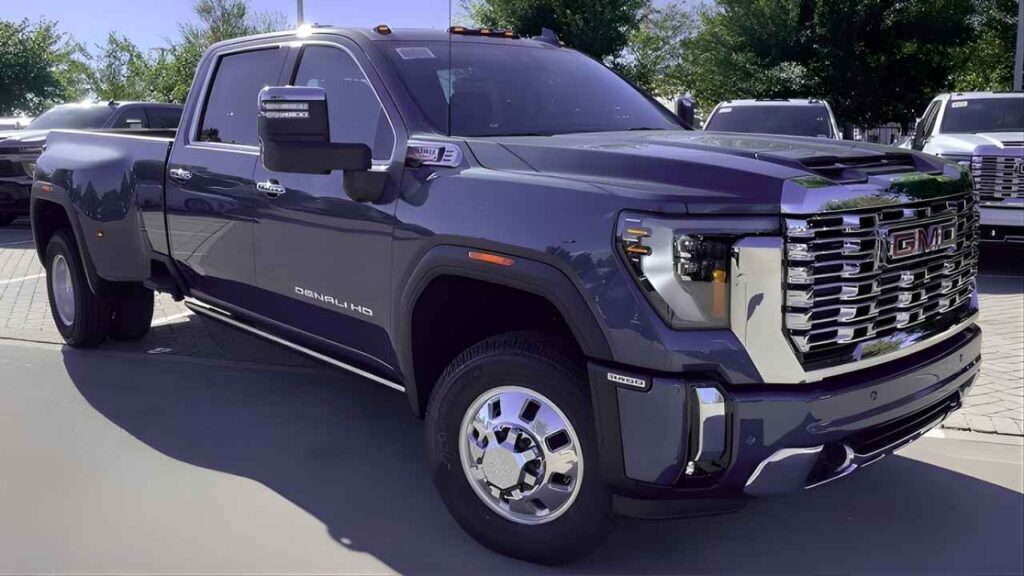

Heavy-duty pickup trucks such as the 2026 GMC Sierra 3500 are commonly used to carry slide-in campers because their frames, suspension components, and rear axles are designed to support continuous vertical load without structural fatigue.
Unlike lighter pickups, a camper-equipped Sierra 3500 treats the living unit as external cargo rather than an interior conversion. The cab remains unchanged, while the cargo bed supports the full weight of the camper assembly.
Whether camper ownership remains practical depends on payload capacity, drivetrain strength, and chassis rigidity. These factors influence braking behavior, steering stability, and component wear.
Read the below article and get to know all the real-world ownership with operational use of the 2026 GMC Sierra 3500 as a camper-carrying platform.
2026 GMC Sierra 3500
The 2026 GMC Sierra 3500 is a full-size pickup built on a reinforced ladder-frame platform. It is offered in multiple cab and bed layouts to match different work requirements.
Ownership priorities typically center on stability, load control, towing confidence, and component longevity. The vehicle serves as a working platform rather than a comfort-first daily driver.
2026 GMC Sierra 3500 Core Specifications
| Vehicle Name | 2026 GMC Sierra 3500 |
| Body Style | Heavy-duty pickup |
| Frame Type | Reinforced ladder frame |
| Cab Types | Regular, Double, Crew |
| Bed Choices | ~2.0 m / 2.5 m [6.5 ft / 8.2 ft] |
| Maximum Payload | Up to ~3,500 kg [~7,700 lb], configuration dependent |
| Rear Axle | Full-floating solid axle |
| Engines | 6.6L V8 gasoline / 6.6L turbo-diesel V8 |
| Output Range | Gas ~300 kW [~401 hp]; Diesel ~350 kW [~470 hp] |
| Fuel | Gasoline or diesel |
| Transmission | 10-speed automatic |
| Drive Layout | RWD or selectable 4WD |
| Tow Rating (general) | Up to ~16,300 kg [~36,000 lb] |
| Practical Camper Mass | ~1,800–3,000 kg [~4,000–6,600 lb] wet |
| Alternator Capacity | Estimated 170–220 A |
| Safety Systems | Stability control, basic driver assistance |
| Price Window | Approx. USD 47,000–95,000 |
| Availability | North American markets |
| Intended Users | Work-oriented camper owners |
Exterior Design – Built to Carry, Not Decorate
The exterior design favors practical operation over styling emphasis. Tall ride height, broad mirrors, and squared body surfaces support visibility, clearance, and durability during work use.
| Exterior Element | Camper Relevance |
|---|---|
| Ride height | Improves ground clearance |
| Mirror size | Supports rear visibility |
| Bed rails | Accept camper tie-downs |
| These features support physical compatibility rather than visual design. | |
2026 GMC Sierra 3500 Variants
Trim selection directly affects remaining payload for a camper. Lower trims retain higher capacity due to reduced curb weight.
- Pro and SLE emphasize simplicity and capacity.
- SLT introduces additional convenience features.
- AT4 adds off-road-focused hardware.
- Denali and Ultimate increase interior and exterior equipment.
Higher trims reduce camper margin without increasing structural strength.
Engine and Transmission Behavior
The 2026 GMC Sierra 3500 emphasizes sustained mechanical output, with engine and transmission tuning optimized for long-duration hauling, towing stability, and controlled power delivery under continuous load.
| Component | Operating Character |
|---|---|
| Gasoline V8 | Operates at elevated engine speeds when heavily loaded |
| Turbo-diesel V8 | Delivers strong torque at low engine speeds |
| 10-speed automatic | Actively adjusts ratios to maintain optimal power |
Measured throttle application supports smoother shifts, reduces driveline stress, and enhances long-term durability during extended towing, hauling, or commercial-duty operation cycles.
Interior Layout
The cabin remains dedicated to driving tasks. Control placement, seating position, and display layout support long working hours without shared or convertible functions. This separation simplifies maintenance and preserves vehicle usability over time.
Chassis Strength and Load Management
The underlying structure determines how the vehicle handles weight.
- Reinforced frame rails resist torsional stress.
- Heavy rear springs support static and dynamic loads.
- Stability systems manage directional movement.
Balanced load placement remains essential for consistent handling.
Bed Fit Is Not Optional Math
Bed choice often greater impact on usability than trim selection. Cargo bed length affects how weight distributes across the chassis.
| Bed Length | Practical Effect |
|---|---|
| Longer bed | Greater flexibility for large loads |
| Shorter bed | Easier maneuverability |
Electrical System Capability
The electrical system supports vehicle operation and auxiliary demands.
- Alternator provides continuous charging
- Factory wiring supports lighting and accessories
- Electrical output aligns with heavy-duty usage expectations.
Supplying Power to the Camper
| Electrical Area | Function |
|---|---|
| Alternator | Charges onboard batteries |
| Factory wiring | Powers lights and signals |
| Engine idle | Supports stationary charging |
Truck electrical systems supplement camper power but do not replace solar or generators.
Towing & Load Capacity
The Sierra 3500 supports very high towing limits when properly equipped. Combining maximum towing with heavy cargo reduces operational margins and requires careful planning.
Technology – Assistance Without Automation
These systems support decision-making but do not manage load or motion independently. Technology features focus on awareness rather than control.
| Feature | Purpose |
|---|---|
| Camera systems | Improve visibility |
| Driver displays | Communicate vehicle status |
Storage and Weight Balance
Cab storage remains accessible in all configurations.
- Door pockets and consoles organize equipment
- Roof-mounted items increase center of gravity
Even weight distribution improves braking and steering predictability.
Fuel Use and Operating Costs
Diesel fuel generally handles sustained work more efficiently, despite higher per-liter cost. Operating expenses reflect vehicle mass and duty cycle.
| Cost Area | Ownership Impact |
|---|---|
| Fuel consumption | Higher than light-duty pickups |
| Tires and brakes | Accelerated wear |
| Maintenance | Heavy-duty service requirements |
Safety Systems – Supportive by Design
Safety systems assist but do not replace driver control. Vehicle size increases stopping distance and turning radius.
- Stability control manages directional corrections.
- Traction control supports grip.
- Camera systems aid visibility.
2026 GMC Sierra 3500 Price
The 2026 GMC Sierra 3500 spans a wide pricing range, with starting costs rising quickly based on trim hierarchy, drivetrain choice, and factory-installed work or luxury packages.
| Trim Level | Starting Price (USD) |
|---|---|
| Pro | Around $50,000 (Approx.) |
| SLE | About $58,000 (Approx.) |
| SLT | Near $70,000 (Approx.) |
| Denali | Roughly $82,000 (Approx.) |
| Denali Ultimate | Approximately $95,000+ (Approx.) |
Final ownership cost depends heavily on configuration, as towing equipment, diesel engines, and premium trims substantially increase the overall transaction price.
Launch & Availability
The 2026 GMC Sierra 3500 enters North American markets through a staggered release, with availability shaped by manufacturing schedules, configuration complexity, and regional dealer allocation strategies.
- Offered throughout the United States and Canada.
- Multiple cab, bed, and drivetrain combinations available.
- Dealer stock varies by trim, engine choice, and workload packages.
- Commercial and fleet orders may follow separate timelines.
Buyers should anticipate differences in lead times, as high-demand configurations and heavy-duty options can extend delivery periods depending on production capacity and local inventory levels.
Who This Vehicle Is Suited For
This pickup suits owners who require consistent towing capability, high payload ratings, and structural durability in a full-size heavy-duty platform.
Long-Term Ownership Outlook
The 2026 GMC Sierra 3500 functions as a purpose-built heavy-duty pickup. Specifications and availability may change. Long-term ownership centers on managing operating costs, component wear, and configuration choices over extended service life.